Friday, March 26, 2010

Crocodiles, Great White Sharks and Cobras

Nothing is better than letters from home! The other day we received this letter from Sheree, Karl’s cousin…

We hope you are enjoying your experience so far – better than you even expected – except for the whole “snake in the kitchen” episode.

The day before we heard about that, Jackson (6 years old) came down from his room holding three of his wild animal cards. He had sorted out the ones that could be found in South Africa and announced with some worry in his voice that, “These are the three animals that could EAT Karl and Julie!”

They were crocodiles, great white sharks and cobras.

I ASSURED him that all of those animals live VERY FAR from Karl and Julie – out in the wild.

But alas, the next day mom was proved wrong! (see the "snake video" if you missed it - http://vimeo.com/10096943)


So now every night Jackson also prays that you all don’t get eaten by crocodiles, great white sharks and cobras. This is in addition to him praying that there wouldn’t be any earthquakes either…so know that you are well covered in prayer by Jackson alone, but the rest of us are praying too – just for good measure.

Thanks, Jackson. We thought we lived VERY FAR from these animals too. But apparently in Africa your kitchen counts as “the wild.”

Friday, March 19, 2010

Three Things I Love About Africa

#1 You can buy avocados at a red light. Seriously – at the “robot” (aka “stop light”) near our home a man walks from car to car selling bags of avocados for less than a dollar.

#2 Buy a Donkey - “Thank you” in Afrikaans sounds like you’re saying “buy a donkey” (Baie dankie). So if someone gives you back change at the grocery store you say “Buy a Donkey.” It seems like you’re unveiling plans for your next big mule purchase – but in actually it’s just a little gratitude.
#3 Pick N Pay – There is a real grocery store here. They do things a little differently – but it’s essentially the same. I do marvel at the name, however. In the states most businesses tend to avoid using the word “Pay” in your company name (people don’t PAY – they SAVE!)

I took a poll of our fellow CPx students (from all of the world, including Africans) and asked “What do you love most about Africa – in 10 seconds?”

Top 10 Things CPx Students Love About Africa:

1. Food (freshest food in the world – especially fruits and veggies)
2. Natural Beauty (back-drop of the ocean, mountains and forest is truly amazing)
3. Soccer (the style of soccer looks more like a dance)
4. Wildlife (penguins, baboons, elephants, ostriches, etc.)
5. Colorful People and Diverse Cultures (a unique blend of western and African cultures)
6. Patterns on the clothing (so colorful)
7. Sun (most days are sunny and warm)
8. Joyful people (even in the worst of circumstances)
9. Hospitable, warm, open people (no one hesitates to invite you into their home for tea)
10. Most people speak multiple languages (as in- more than 2 languages – it’s impressive – I feel like they often have to accommodate the poor American that only knows 1 language)

Friday, March 12, 2010

Low Carbs, the StairMaster and Good Genes are Overrated

Have you heard about this?

Roseto, a little Italian community in Pennsylvania in the 1960’s, had no suicide, alcoholism, drug addiction and very little crime. No one was on welfare or had ulcers.
The death rate from heart disease was about 50% lower than expected. In fact the death rate from ALL causes was 30%-35% lower than the United States as a whole.

I’m reading “Outliers” by Malcolm Gladwell (a book about the unexpected pattern behind success) and it talks about Roseto. They couldn't figure it out!

At first they wondered if it was diet – perhaps the Rosetans were using some healthier Old World cooking practices? But they discovered they used just as much lard, sugar and fat as the average American. They didn’t exercise particularly much, smoked and struggled with obesity.

Then they looked into genetics – thinking that perhaps they all came from a hardy stock that protected them from disease. Not the case – as other decedents from the same town in Italy who did not settle in this little Roseto were not as healthy as their Rosetan cousins.

They also considered the possibility that maybe there was something special about the foothills of eastern Pennsylvania that was good for health. Another dead-end – as near-by towns did not have the same glowing health records.

After a while they realized it was the town itself.


“What (they) began to realize was that the secret of Roseto wasn’t diet or exercise or genes or location. It had to be Roseto itself. As (they) walked around the town, they figured out why. They looked at how the Rosetans visited one another, stopping to chat in Italian on the street, say, or cooking for one another in their backyards. They learned about the extended family clans that underlay the town’s social structure. They saw how many homes had three generations living under one roof, and how much respect grandparents commanded. They went to mass at Our Lady of Mount Carmel and saw the unifying and calming effect of the church. They counted twenty-two separate civic organizations in town of just under two thousand people. They picked up on the particular egalitarian ethos of the community, which discouraged the wealthy from flaunting their success and helped the unsuccessful obscure their failure.”

They didn’t have any less stress or problems than anyone else – they just had each other. Community in the truest sense produces better health and life expectancy than good diet, exercise or genes.

I was fascinated. I had to know more!

I researched the current status of Roseto and found that after interviewing town citizens in the 1960’s, researchers predicted the town would change, as the youth at that time had more “modern” ideas.

The town did change. Unfortunately.

The people of Roseto don’t go to church as much, stopped naming first born children after grandparents, put older people in nursing homes (instead of keeping them with the family), and are no longer concerned with hiding wealth and bought flashy cars.

Essentially selfishness was killing them. Literally.

Who has time to go to church? Who has the energy to take care of aging family members? Who doesn’t want to show off with a few impressive possessions?

Roseto makes me think of Africa townships.

There certainly is a sense of community here – people don’t hesitate to invite you into their home. It’s not unusual to find three generations living together. And they all seem to go to church.

But something’s missing. The death rate and level of disease is horrific, and crime is off the charts.

The family structure here has completely fallen apart – and I think that’s the key. Family.

Rosetans had family. Real deal family. Not just the basics – mothers and fathers (most homes here do not have both parents) – but grandparents – and essentially a whole neighborhood that functioned like family.

That’s what I want.

We are learning to live in community here at All Nations –this close knit group of strangers from all over the world. There is something to be said for cooking together, cleaning together, playing together, praying together and working together. Being family.

I want to have this lifestyle of “family” – wherever we go….making strangers feel like neighbors….making relationship more important than accomplishment…making time for the seemingly unimportant. I think this is what Jesus did all the time.

It seems family is better than vitamins, gym memberships and perfect genes. Huh!


Wednesday, March 3, 2010

I No Speaka English.

Apparently it’s me that doesn’t speak English.

I keep using the wrong terminology and people look at me like they really want to understand - but honestly have no idea what I’m saying.

SOUTH AFRICAN TERMINOLOGY TO NOTE


1. AT A RESTAURANT

- "Take Away" food is "To Go" food
- "Chips" are "fries"
Do you want to take away your chips? (Do you want your fries to go?).
What I'm thinking: Please don't take away my fries.

2. CHORES

- "Tumble Dry" is the "clothes drier" - as opposed to wash line drying
- “Nappy” is diaper
I'll change Emme's nappy then tumble dry her pants (I’ll change Emme’s diaper then put her pants in the drier).
What I'm thinking: Isn't "nappy" what Emme does in the afternoon while she's sleeping?


3. IN THE KITCHEN
- “Crockery” is “dishes”
- “Cutlery” is “silverware”
- A “serviette” is a “napkin”
- A “tap” is a “facet” (you "open" it - instead of "turning it on")
Throw away your serviette and open the tap to wash your crockery and cutlery. (Throw away your napkin and turn on the facet to wash your dishes and silverware.).
What I'm thinking: What??!?

4. ON THE STREET

- “To pitch” is to “show up”
- A “robot” is a “stop light”
- A “traffic fine" is a “speeding ticket”
- A “speed cob” is a “police man"
- “Skipped” for “ran through”

I didn’t pitch at the meeting because I got a traffic fine from the speed cop when I skipped the robot (I didn’t show up at the meeting because I got a ticket from the police man when I ran through the red light).

What I'm thinking: I don't get it! Whenever someone says "turn left at the robot" I can't help but picture Rosie, the Jetson's maid, out on the streets of Africa directing traffic.

5. AT THE BEACH

- Costume is a "swimming suit"

You're going to the beach? Let me get my costume! (You're going to the beach? Let me get my swimming suit!)

What I'm thinking: Wow! They wear costumes to the beach here? THIS I've got to see! It was very disappointing to realize a costume is only a swimming suit. If only we wore costumes to the beach!

Monday, March 1, 2010

The White-ies are Coming!

Walking through Ocean View (the township where we are working several days a week) the children were shouting in Afrikaans, “The White-ies are coming! The White-ies are coming!”

Well, I can’t say I’ve ever been called a White-ie before. But I guess I am – a White-ie that is. I was with my White-ie husband and White-ie kids. We can’t help but feel rather pasty in all our whiteness.

Jensen however – doesn’t know she’s white – and I don’t think we’ll be mentioning that to her any time soon.

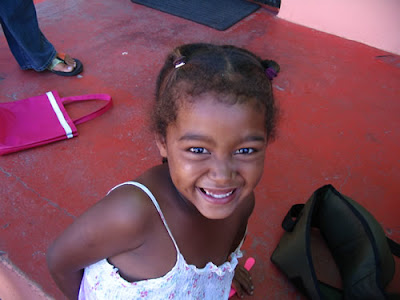
Here are some friends she's made in Ocean View.

Note: Ocean View is the least "poor" of three communities where All Nations works. However, it's plagued with unemployment, crime, rape and murder.

Thursday, February 4, 2010

Africa - Same, Same...but Different

After 10 days in Cape Town, here are 10 ways Africa is the same – but oh so different.

1. The plugs. Obviously you need a converter. Not only are the little plug thingies a different size (which calls for one converter), but sometimes the voltage is wrong on certain items (hair dryer, Karl’s head shaver, etc.) and you need a second converter. I have a hard time remembering which items require what converter and am likely to burn the house down any moment.

2. The roads. Not to belabor the point, but the driving is on the left side of the road, which means the steering wheel is the right side. I think a few of the knobs turn the wrong way too (but Karl thinks I may be imagining this). I'm all turned around and think I'm going to die everytime Karl makes a left-hand turn.

3. The locks. Every door in this house has a different lock with a different key. You can’t turn a knob to lock it from the inside, as with most homes in the US, you actually have to have the right key for that room. So you go into the bathroom and lock it with a key from the inside. Don't loose a key!

4. Setting up your cell phone:

Setting up your phone in Omaha:
1) Go to the Sprint store, choose a phone, and pick a monthly package.
2) Start calling people.

Setting up your phone in South Africa: a 12 Step Program
1) Make sure you have a GSM compatible phone (used in most of the world except in the United States). They use SIM cards to operate (your average US cell wouldn't work here).
2) Go to the store and buy a SIM card. We bought ours in what I would call a South African TJ Max, but not quite that nice.
3) Register your SIM card with the government. This involves your passport, local address, documentation of residence, and something else I can’t remember. They can decline to register the SIM if they chose to do so, but ours made it through the “screening process”.
4) Install SIM card in phone and dial “100” to activate.
5) Wait 24 hours
6) Go to gas station, phone store, grocery store or someplace like that and purchase “air time” for your SIM card. Everything is pre-paid up front. No monthly packaged phone plans.
7) Enter in the given code for your purchased air time.
8) Wait 8 hours (why 8 you ask and not 9 or 24 hours again – is not clear)
9) To purchase data (for emails or Twitter updates), go back to the phone store to purchase (can’t do this one at the gas station)
10) Wait another 24 hours (some kind of security thing)
11) If this all works, you are done. If not, go back to the phone store like Karl did 2 more times.
12) We now appear to be working. Here are our South African telephone numbers.

  • Karl's # 011 27 (79) 743-3692
  • Julie's # 011 27 (79) 910-4911
5. Setting up internet in South Africa:

1) See above steps #2, #3, #4, #5, #9, #10, #11, #12 (#12 is still in process)
2) That’s it
3) Forgot to mention that you are charged for internet here by the bandwidth. Thus it’s rather pricy to download music, movies, photos and video. Man we miss unlimited internet!
6. Purchasing electricity for your residence. No, they don’t just send you a monthly bill. EVERYTHING in this country appears to be pre-paid. We have been staying at the home of a family for the first ten days. They went back to Holland for a month and told us we needed to buy electricity or we would be in the dark. Here is the process:

1) Take the “electricity card” to you, guessed it, the gas station
2) Purchase the desired units of electricity.

We goofed up a little here. The card we thought was the correct card actually was a card for a different house…a whole different address. Somehow we purchased electricity for some nice neighbor of ours. No refunds allowed. When we explained the problem, the gas station worker recommended that we go to the address on the card (of a complete stranger), explain to them that we accidently bought them some electricity and ask them to give us our 100R (about $13). Hmmm…maybe not.

3) Find the correct card.
4) Go back to the gas station again.
5) Purchase the desired units of electricity again.
6) Go back home and punch in the code in a big black box on the wall in the living room. (This seemed a little like Locke punching in 4 8 15 16 23 42 - for you “Lost” fans.)
7) Turn on the lights!

7. Hand washing dishes and line drying clothes. Not too bad, unless I forget to turn on the backyard hose to the washer (I’ve run a whole wash with no water), or it doesn’t rain (like it did to this batch of laundry after the photo was taken) or the wind doesn’t blow over your line dryer thing and your clothes are dirtier than when you started.

8. Remember to weigh your fruits in the FRUIT SECTION at the grocery store. I think I’ve forgotten 3 times now. I get up to the cash register, expecting them to know the total on my grapes, and they tell me to go back and get them weighed (some lady in the fruit section weighs your fruit and marks it – just like the deli counter does with sliced ham back in Omaha).

9. Tip the parking attendants. Everywhere you go there is a nice man to show you where to park (which slots are open). Even though it seems like this may be one of the few things we are actually capable of figuring out ourselves, someone is there to assist. Apparently it’s best to tip when you return, to ensure your car is still there when you get back.

10. Watch out for baboons. Seriously. The front page article in the paper today was how a baboon purposely pushed a man over a ledge and he plunged to his death (a few miles from our home). Apparently these are very bitter baboons.

Monday, February 1, 2010

Africa - Arriving (a travel recap)


1. Boarding at Eppley – Well, in all our crazy packing, I somehow lost track of “carry on” suitcase rules. Omaha security was not impressed with my 16 oz bottles of shampoo, lotion and hair stuff. I’ve tried to replace the items here - but it’s not quite the same (instead of “bed head” they carry something called “out of bed"). I did manage to inadvertently carry on Jensen’s craft scissors – it disturbs me greatly that my hair gel was detained, but a sharp, metal weapon of potential untold destruction goes unnoticed.

2. On our first layover in Minneapolis – I called my mom on the plane and found out that my dad has to start Chemo therapy for his cancer (lymphoma) right away. He had been in a holding pattern where treatment was not required for about 2 years. He has a check-up every 90 days (when I found out a few months ago that his next appointment just happened to be the day we were to fly out – I had a bad feeling he would get the news to start the dreaded treatments). I am so sad we are not there for this! Please pray for my dad to have few side effects (and some sunny Omaha days - he loves the sun more than anyone I know and actually keeps track of sunny vs. cloudy days on his calendar).

3. On our second layover in Amsterdam - Karl discovered they didn’t have any record of us being on the flight. That was fun. He wasn’t afraid to pull the “special needs kid” card. Emme got us on that flight. Speaking of Emme - unlike most babies - she didn't bother the other passengers with her crying. She did however surprise them a bit with her high-volume laughing - sometimes shockingly LOUD shrieks of laughter.

4. When we landed in Cape Town at midnight and were walking to our car – Jensen kept saying, “I’ve never seen this before! I’ve never seen this before!” You can say that again, Jensen.

Note on time change:
I wisely decided it would be a good idea to quit my job one week before we left. Essentially this translated to staying up till 4 am every night that last week to try to” get it all done.” So after a 24 hour flight (that allowed for a few hours of sleep here and there), we arrived at midnight, exhausted, and all got a full night of sleep. Miraculously – we’ve adjusted to the time change. Cape Town is 8 hours ahead of Omaha time (so noon in Omaha is 8 pm here).